What is aquaponics?
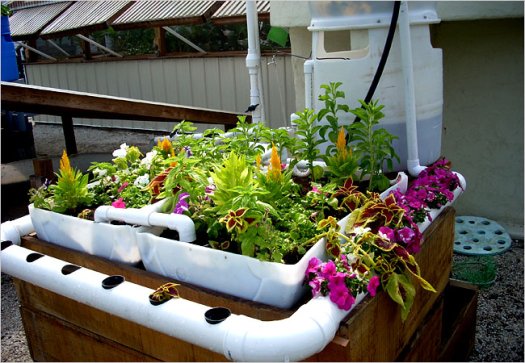
Aquaponics consists of two main parts, with the aquaculture part for raising aquatic animals and the hydroponics part for growing plants.[18][19] Aquatic effluents, resulting from uneaten feed or raising animals like fish, accumulate in water due to the closed-system recirculation of most aquaculture systems. The effluent-rich water becomes toxic to the aquatic animal in high concentrations but these effluents are nutrients essential for plant growth.[18] Although consisting primarily of these two parts, aquaponics systems are usually grouped into several components or subsystems responsible for the effective removal of solid wastes, for adding bases to neutralize acids, or for maintaining water oxygenation.[18] Typical components include:
- Rearing tank: the tanks for raising and feeding the fish;
- Settling basin: a unit for catching uneaten food and detached biofilms, and for settling out fine particulates;
- Biofilter: a place where the nitrification bacteria can grow and convert ammonia into nitrates, which are usable by the plants;[18]
- Hydroponics subsystem: the portion of the system where plants are grown by absorbing excess nutrients from the water;
- Sump: the lowest point in the system where the water flows to and from which it is pumped back to the rearing tanks.
Depending on the sophistication and cost of the aquaponics system, the units for solids removal, biofiltration, and/or the hydroponics subsystem may be combined into one unit or subsystem,[18] which prevents the water from flowing directly from the aquaculture part of the system to the hydroponics part.
It is in relation too hydroponics

Plants are grown as in hydroponics systems, with their roots immersed in the nutrient-rich effluent water. This enables them to filter out the ammonia that is toxic to the aquatic animals, or its metabolites. After the water has passed through the hydroponic subsystem, it is cleaned and oxygenated, and can return to the aquaculture vessels. This cycle is continuous. Common aquaponic applications of hydroponic systems include:
- Deep-water raft aquaponics: styrofoam rafts floating in a relatively deep aquaculture basin in troughs.
- Recirculating aquaponics: solid media such as gravel or clay beads, held in a container that is flooded with water from the aquaculture. This type of aquaponics is also known as closed-loop aquaponics.
- Reciprocating aquaponics: solid media in a container that is alternately flooded and drained utilizing different types of siphon drains. This type of aquaponics is also known as flood-and-drain aquaponics or ebb-and-flow aquaponics.
- Other systems use towers that are trickle-fed from the top, nutrient film technique channels, horizontal PVC pipes with holes for the pots, plastic barrels cut in half with gravel or rafts in them. Each approach has its own benefits.[20]
Most green leaf vegetables grow well in the hydroponic subsystem, although most profitable are varieties of chinese cabbage, lettuce, basil, roses, tomatoes, okra, cantaloupe and bell peppers.[19] Other species of vegetables that grow well in an aquaponic system include beans, peas, kohlrabi, watercress, taro, radishes, strawberries, melons, onions, turnips, parsnips, sweet potato and herbs.[citation needed] Since plants at different growth stages require different amounts of minerals and nutrients, plant harvesting is staggered with seedings growing at the same time as mature plants. This ensures stable nutrient content in the water because of continuous symbiotic cleansing of toxins from the water.[21]
where it is that Animals&hydroponics come together creating a aquaculture or sibiotic relationship that nature already provides.

Freshwater fish are the most common aquatic animal raised using aquaponics, although freshwater crayfish and prawns are also sometimes used.[22] In practice, tilapia are the most popular fish for home and commercial projects that are intended to raise edible fish, although barramundi, Silver Perch, Eel-tailed catfish or tandanus catfish, Jade perch and Murray cod are also used.[19] For temperate climates when there isn't ability or desire to maintain water temperature, bluegill and catfish are suitable fish species for home systems. Koi and goldfish may also be used, if the fish in the system need not be edible.
Bacteria
Nitrification, the aerobic conversion of ammonia into nitrates, is one of the most important functions in an aquaponics system as it reduces the toxicity of the water for fish, and allows the resulting nitrate compounds to be removed by the plants for nourishment.[18] Ammonia is steadily released into the water through the excreta and gills of fish as a product of their metabolism, but must be filtered out of the water since higher concentrations of ammonia (commonly between 0.5 and 1 ppm)[citation needed] can kill fish. Although plants can absorb ammonia from the water to some degree, nitrates are assimilated more easily,[19] thereby efficiently reducing the toxicity of the water for fish.[18] Ammonia can be converted into other nitrogenous compounds through healthy populations of:
- Nitrosomonas: bacteria that convert ammonia into nitrites, and
- Nitrobacter: bacteria that convert nitrites into nitrates.
In an aquaponics system, the bacteria responsible for this process form a biofilm on all solid surfaces throughout the system that are in constant contact with the water. The submerged roots of the vegetables combined have a large surface area, so that many bacteria can accumulate there. Together with the concentrations of ammonia and nitrites in the water, the surface area determines the speed with which nitrification takes place. Care for these bacterial colonies is important as to regulate the full assimilation of ammonia and nitrite. This is why most aquaponics systems include a biofiltering unit, which helps facilitate growth of these microorganisms. Typically, after a system has stabilized ammonia levels range from 0.25 to 2.0 ppm; nitrite levels range from 0.25 to 1 ppm, and nitrate levels range from 2 to 150 ppm.[citation needed] During system startup, spikes may occur in the levels of ammonia (up to 6.0 ppm) and nitrite (up to 15 ppm), with nitrate levels peaking later in the startup phase.[citation needed] Since the nitrification process acidifies the water, non-sodium bases such as potassium hydroxide or calcium hydroxide can be added for neutralizing the water's pH[18] if insufficient quantities are naturally present in the water to provide a buffer against acidification. In addition, selected minerals or nutrients such as iron can be added in addition to the fish waste that serves as the main source of nutrients to plants.[18]
A good way to deal with solids buildup in aquaponics is the use of worms, which liquefy the solid organic matter so that it can be utilized by the plants and/or animals.
Operation
The five main inputs to the system are water, oxygen, light, feed given to the aquatic animals, and electricity to pump, filter, and oxygenate the water. Spawn or fry may be added to replace grown fish that are taken out from the system to retain a stable system. In terms of outputs, an aquaponics system may continually yield plants such as vegetables grown in hydroponics, and edible aquatic species raised in an aquaculture. Typical build ratios are .5 to 1 square foot of grow space for every 1 US gal (3.8 L) of aquaculture water in the system. 1 US gal (3.8 L) of water can support between .5 lb (0.23 kg) and 1 lb (0.45 kg) of fish stock depending on aeration and filtration.[23]
Ten primary guiding principles for creating successful aquaponics systems were issued by Dr. James Rakocy, the director of the aquaponics research team at the University of the Virgin Islands, based on extensive research done as part of the Agricultural Experiment Station aquaculture program.[9]
- Use a feeding rate ratio for design calculations
- Keep feed input relatively constant
- Supplement with calcium, potassium and iron
- Ensure good aeration
- Remove solids
- Be careful with aggregates
- Oversize pipes
- Use biological pest control
- Ensure adequate biofiltration
- Control pH
Feed source
As in all aquaculture based systems, stock feed usually consists of fish meal derived from lower-value species. Ongoing depletion of wild fish stocks makes this practice unsustainable. Organic fish feeds may prove to be a viable alternative that relieves this concern. Other alternatives include growing duckweed with an aquaponics system that feeds the same fish grown on the system,[24] excess worms grown from vermiculture composting, using prepared kitchen scraps,[25] as well as growing black soldier fly larvae to feed to the fish using composting grub growers.[26]
Water usage
Aquaponic systems do not typically discharge or exchange water under normal operation, but instead recirculate and reuse water very effectively. The system relies on the relationship between the animals and the plants to maintain a stable aquatic environment that experience a minimum of fluctuation in ambient nutrient and oxygen levels. Water is added only to replace water loss from absorption and transpiration by plants, evaporation into the air from surface water, overflow from the system from rainfall, and removal of biomass such as settled solid wastes from the system. As a result, aquaponics uses approximately 2% of the water that a conventionally irrigated farm requires for the same vegetable production.[citation needed] This allows for aquaponic production of both crops and fish in areas where water or fertile land is scarce. Aquaponic systems can also be used to replicate controlled wetland conditions that are useful for water treatment by reclaiming potable water from typical household sewage.[citation needed] The nutrient-filled overflow water can be accumulated in catchment tanks, and reused to accelerate growth of crops planted in soil, or it may be pumped back into the aquaponic system to top up the water level.
Energy usage
Aquaponic installations rely in varying degrees on man-made energy, technological solutions, and environmental control to achieve recirculation and water/ambient temperatures. However, if a system is designed with energy conservation in mind, using alternative energy and a reduced number of pumps by letting the water flow downwards as much as possible, it can be highly energy efficient. While careful design can minimize the risk, aquaponics systems can have multiple 'single points of failure' where problems such as an electrical failure or a pipe blockage can lead to a complete loss of fish stock.
n aquaponic system that involves tilapia or perch, watercress and tomatoes. The water is drawn up through one pump and gravity fed through the potted plants (which remove the nitrogen from the fish waste) and back into the tank where it re-oxygenizes the tank water. (Photo: grifray/Flickr)
 "Fish
waste is actually ammonia, that through an aquaponics system, gets
broken down into nitrites and then nitrates. The nitrates is what the
plants love and are constantly taking up as food," says Nikhil Arora,
one of the founders of Back to the Roots. "So you're not really growing your food of fish waste, but rather nitrates."
"Fish
waste is actually ammonia, that through an aquaponics system, gets
broken down into nitrites and then nitrates. The nitrates is what the
plants love and are constantly taking up as food," says Nikhil Arora,
one of the founders of Back to the Roots. "So you're not really growing your food of fish waste, but rather nitrates."